Sunday, February 18, 2007

Jesus of the Tree


Last week in Crystal City, Texas, Betty Jo Hernandez espied Jesus in this tree. She saw more than His face, though; the nob of wood that resembles a hung head, the reach of the branches, the mottled bark and the slivered gap in the trunk looked enough like Christ being crucified for her to snap some photographs and show them around to her friends. Sure enough, word spread, attracting hundreds of visitors to the tree.


This article from MySA.com includes a slide show, which features the tree and the shrine that now resides at its base.

Most interesting about this Jesus sighting is that the owners of the property where the tree stands have been keeping low profiles, wanting to stay outside the public gaze. Having talked to lots of people who have been on the receiving end of such attention, I can't blame these folks in Texas for wanting to remain anonymous. Some people find such events silly, while others deify them, and still others dismiss them as blasphemous. For all of the goodwill generated by many of these visitations, the issuing of threats is not uncommon, and even those lucky enough to avoid bilious banter still lose their privacy. While interviewing people for Madonna of the Toast several of them told me that if they ever spotted another recognizable face, they'd keep it to themselves.

Tuesday, February 13, 2007

"Faces, Faces Everywhere"


Up late last night, I checked email around 2:00 a.m. and found a note from my friend Robert Anasi, a man that knows about boxing and the real Indiana Jones. He was the first of many people to direct me to an article in today’s New York Times called “Faces, Faces Everywhere.” Printed in the Science Times section, the writer opens the piece by evoking Diana Duyser and her Virgin Mary Grilled Cheese Sandwich, which eventually sold on eBay for $28,000. After mentioning a few other high-profile examples of recognizable faces showing up in unexpected places (most of which are included in Madonna of the Toast) the article takes a very cursory look at the scientific process that hopes to identify how and why humans tend to recognize human form in burns, rock outcroppings and anywhere else you can imagine.

While my examination of these phenomena leans towards the cultural ramifications of such discoveries, the piece in the Times bowled me over for a few reasons. First off, I’m psyched that the powers-that-be at the Times deemed this subject worthy of inclusion in the paper. While science has yet to provide any concrete neurological reasons for why we see iconic faces in all sorts of surprising places, the more tangible indicators of human action (like media exposure and money spending) prove what I try to bring out with all the examples in the book, namely that it’s not so much about why we see the faces, but how what we see drives people to action: the media converges, large sums of money are spent, people make pilgrimages.


It amazed me that the “paper of record” was unable to locate Duyser for comment. I speak with her frequently. I would have happily arranged for Duyser to comment on the piece, as this half-a-sandwich has made an indelible impact on her life.

Lastly, nowhere in the article is the psychological phenomenon of pareidolia mentioned. It seems like a gross omission, considering that the piece uses science as its point of entry. I’ve already mentioned pareidolia in very unscientific terms on here over the last couple of days, so I’ll spare you more on that subject.

Overall, this strikes me as a very positive development for the book. Maybe one of these days the Times will come to me and ask me what I think about all of this. If they don’t, at least you can come here and get a sense, and if you’re really keen to read what I think, you can always buy the book!

Monday, February 12, 2007

Tom Waits and Me

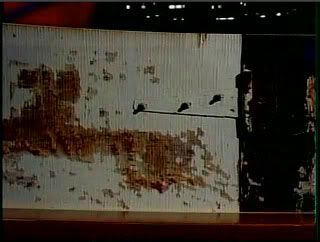
I’ve never met Tom Waits, though I know folks who have recorded with him. I knew at some point that I would have a good reason to reference the Waits song “Chocolate Jesus” on here (especially since Madonna of the Toast includes a chocolate Virgin Mary). Looking at email today, Garth Risk Hallberg provided me with a Waits-related tidbit of information pertaining to Orphans, the recent Waits box set. Three discs containing all sorts of outtakes and other rare material comprise the release (and feature my pals Colin Stetson, Ara Anderson and Eric Perney, among many, many others), and apparently there is also a little book that details the process of excavating many of these tracks from basements and Russian plumbers. Hallberg notified me of the fact that the book includes this photograph of a horse-like shape on a barn door.


Another example of pareidolia. More than just a random image of a horse formed by peeling paint, this horse picture was “gummed” by an actual horse over many years! So maybe the form is intentional. Apparently, Waits discussed all of this during his last appearance on Letterman, but I can’t find it on Youtube, so instead, enjoy this performance of “Chocolate Jesus” from another Waits appearance on the Late Show.


And Tom, if you’re reading this, we should swap stories. Doesn't seem like too much of a stretch imagining you penning a song called "Cat-Ear Rasputin." I’ll actually be in your neck of the woods on March 10 at Hotel Utah in San Francisco for a book launch party (more details to follow). Come on by and say hello!

Friday, February 9, 2007

It's Not Only Faces that We See


As reported in the Times-Herald in Newman, GA, just last month. The article title: "I'm Showering with Jesus."

Just goes to show you, there's more to stare at in the shower than your bellybutton.

Thursday, February 8, 2007

Pareidolia

For those of you keeping score at home, you’ll have undoubtedly noticed that my last couple of posts have featured objects that have been clearly contrived, in that no one is waving them around claiming that they unexpectedly appeared, only noticed as the toast sat in wait of being slathered with butter and jam. They are nothing more than crusty bits of satire.

While readers of Madonna of the Toast may cast skeptical glances upon some of the objects in the book, the people responsible for discovering the objects maintain that these visual manifestations have nothing to do with them, aside from the fact that they heated up the pan or squeezed the bottle of lotion. The folks that I spoke with believe that their findings came to light because of divinity, or physics, or chemistry, or without any good reason aside from the fact that they happened.

There is a term for these sorts of occurrences: pareidolia. A very basic definition for this term, as it applies to Madonna of the Toast, is that as humans, our brains are hardwired to recognize human forms in everything.

From random rocks:


To water stains:


And this is what is really interesting about pareidolia: the tendency for people to not only recognize the lines and curves of human noses, chins, eyes and entire bodies, but that people recognize combinations of these shapes that remind them of recognizable figures, no matter if the figure is sacred or secular.

This is what generates swarming media hubbub. If I revealed a beer-coaster stain that resembled my Uncle Mark, I doubt you’d ever see me talking about it on CNN. But, if I touted a burn scar on my forearm that was the spitting image of Paula Abdul, you better believe I could get some attention for that. (Note to self: Find someone to make me a Paula Abdul branding iron.)

These stories are remarkable because they elicit action, from the people who find them to the people that want to gawk. It is fair to say that most of the people I chose to feature in the book got a lot more than they bargained for when they found themselves looking at something, recognizing it and then saying to anyone within earshot, “What do you see?”

Because when more than one person sees something in a place where it’s not meant to be, that sighting takes on meaning, and in meaning people root belief. Belief can take shape many ways, but it is a core human trait, and in that sense, all of these instances share a common factor: they are byproducts of the human condition, something none of us can escape (with the exception of all you aliens reading this blog).

Tuesday, February 6, 2007

Another Madonna of the Toast


Tis true fair reader, tis true. Posted just the other day on the Booman Tribune, some sort of online community that has a soft-spot for dogs and Democrats. Not quite sure of the connection, but I am becoming more and more intrigued by the fact that canines have become regular subjects of this blog.

If the Democrats drop the ball, perhaps the dogs shall inherit the Earth...

Monday, February 5, 2007

Charlotte Bronte on Toast

There is a blog called The Millions. Several reviewers contribute regularly, meditating on the world of books. One of these folks, Garth Risk Hallberg (an astute and deft reviewer), was kind enough to plug this blog on that blog. Hallberg gives a brief synopsis of my book, and then directs people here to learn more. In doing so, he suggests, facetiously, "If you've recently run across a Charlotte Bronte-shaped under arm stain, or a puddle that looks like William Shatner," that you should check out my modest little project.

If you're reading this, I assume that you don't need to be told how blogs speak to other blogs, distilling keywords into additional webbing that bindingly extends this networked world. And if you do need the process explained -- I'm not the guy to do it, because I don't get it, and as I get more involved with it, I feel like an explorer entering into a never-ending landscape that leads everywhere, though it takes you nowhere.

But I digress . . .


This is an image of a Charlotte Bronte on a piece of humble toast! It's been a long time since I've read Jane Eyre, and it probably will be an even longer time before I read it again. But, thanks to some cursory Googling it is clear that Bronte's protagonist swoons over the simple, crusty pleasures of a fine piece of toast.

The Bronte Toast was made public 150 years to the day after Bronte died, which according to my calendar math dates this toast to March 31, 2000. There's not much written about the Bronte Toast, and it seems clear that it was a rather erudite jape by photographer Alec Norbet-Troth, as the brief article draws a parallel between this baked-good countenance and those so common here in America (though Madonna of the Toast contains several British examples of these phenomena).

Charlotte Bronte, being a literary giant, has a blog dedicated to her; it's called the Bronte Blog. One of their intrepid researchers discovered the blog post written by Hallberg and then re-launched the Bronte Toast into the Blogoshpere.

I suppose these days, it all just orbits forever . . .