The Boston Globe’s website reported last week that the Mercy Medical Center in Springfield, Massachusetts, will remove the window upon which the image of Virgin Mary was spotted, and subsequently attracted hundreds of visitors. Says hospital spokesperson Mark Fulco, “Removal of the window is not only a prudent decision at this point but is necessary for returning to normal operations.” The widow will be studied and then perhaps made into a display. Fulco, echoing a message from the local Bishop, asked that “attention now be placed on prayers for the people in the hospital as well as the sick and infirmed throughout our world.”

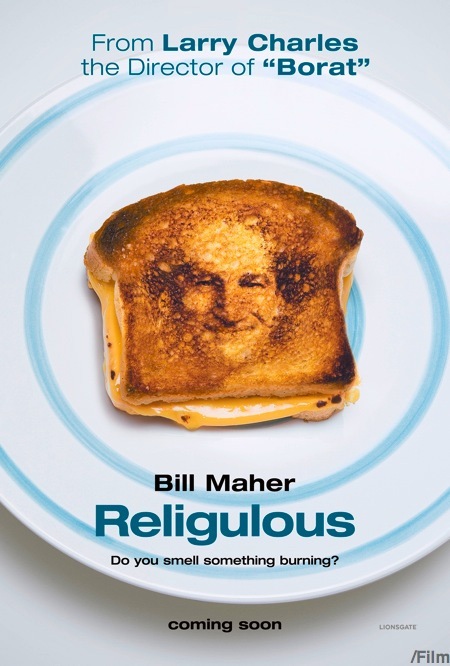
These were the kinds of stories that I had hoped Bill Maher’s new movie would cover. But, aside from the poster’s toasted countenance of Maher, there really isn’t that much directly in common between Religulous and Madonna of the Toast. I thought there would be. I thought that he would be lampooning the commercialization and media sensationalized aspects of religion by making examples of these stories that anyone reading this is fond of, for whatever reason, be it religion or absurdist comedy. But that’s not what the movie is about.
In Maher’s words, he is “preaching doubt,” asking what’s so great about faith. What has made Maher popular, and a reason I have been a fan of his since Politically Incorrect, is his ability to get under people’s skin, pushing all the right buttons so as to bait answers – or more accurately lack of good answers – in order to make his point. He’s done it with politicians, celebrities, activists, writers and now with self-proclaimed true believers.
Unfortunately, the movie only focuses on Christianity, Judaism and Islam, making the glaring omissions of Hinduism, Buddhism, Paganism and really any other –ism you can think of a real shortcoming for a movie that calls into question the notion of “faith.” That’s the disconnect – if Maher were really looking to pick a fight with humanity’s panache for faith, he would really have to go after ALL religions. The movie would have been more successful had Maher better identified what really drives him nuts about faith: hypocrisy and self-serving contradictions that take advantage of people looking for answers to life’s mysteries and hardships.

So, the interviews with Jeremiah Cummings and Jose Luis de Jesus Miranda play right into Maher’s objective: to reveal how religion, for these two, is a means to bilk money from their respective congregations so as to keep them dressed in fine tailored suits.
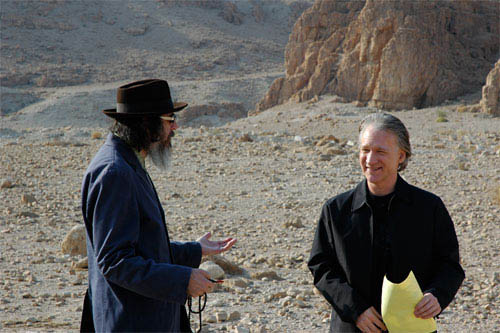
But, when he talks with Rabbi Yisroel Dovid Weiss, an anti-Zionist Jew infamous for going to meet with Iranian President Ahmadinejad, Maher shows his hand; he only really wants to talk to people with answers that are caricatures that he knows are coming, playing into his true agenda – to make these people look like hypocritical idiots (some of them are). But the rabbi does not let Maher get a word in edgewise, which frustrates Maher enough that he abruptly ends the interview. It’s a great scene because both men are accustomed to talking their ways around interlocutors. In this case, Weiss betters Maher by answering questions with orations that Maher interrupts with a different question. The new question only spurs a new oration, however, taking Maher off his talking points.
Maher is preaching to the choir in Religulous. No one struggling with a dilemma of faith will walk out of the theatre with their troubles assuaged because Maher doesn’t really tackle the issue of faith, at least not as it applies to all belief systems. He reminds viewers that the Jesus story borrows heavily from the story of the Egyptian god Horus. This is not news to serious students of religion and myth and I imagine most people who see the film will know this, and will appreciate most of Maher’s points.
There are a few moments, however, where Religulous dovetails with Madonna of the Toast, and that is when individuals are talking about their faith, not as a means to proselytize but to simply get through life. Such is the case with the truckers he interviews at a truck-stop church. One driver in particular tells Maher, “When I seen what I seen, you can’t change what I believe.” This guy isn’t talking about seeing the Virgin Mary on a window. He’s talking about how faith pulled him out of a bleak life of addiction. So, for this guy, faith did factor into making life better. If it had been an image of Mary that got him around the bend, it’s really the same metaphor, right? This guy saw something, thought about what it meant to him and changed his behavior based on this vision.
Maher asks, “Why is faith good?” This isn’t a hard question to answer. Faith on an individual level is inevitable, whether it is religious or agnostic. At one point Maher posits, “Doubt is humble.” That’s tough to argue, but it is a statement of belief, no different than a statement of faith: “I believe . . .” The tough questions deal with how and why faith is used to take advantage of people or to sell a product.
I credit Father Reginald Foster, not Bill Maher, for getting in the best line of Religuous. The Catholic priest and Vatican Scholar tells Maher, as the two are standing outside the Vatican: “You have to live and die with your stupid ideas.” “Your” is the key word here. We are inundated with ideas from friends, family, media, religions, governments and academies. It is up to us to interpret them and live with our interpretations. Yes, certain of these ideas are biased, illogical and inconsistent, but that’s not a secret. Yes, some people are not necessarily equipped to make those distinctions, but is that the fault of the ideas, or the reason for them? I think it is the latter, which is a hugely more profound and complex question than the point of faith.
All of these bodies of ideas are human creations, no different from the wheel, the printing press and computers, and they should be examined as such. While Religulous offers some genuinely funny moments, it only skims the surface of “faith” as an idea. Maybe that’s for the sequel, the one that Maher and his director Larry Charles will let me help write.
I’m off to Frankfurt for the Book Fair, so I won’t be posting for a while. But, if any of you readers have seen Religulous, I’m interested to read your thoughts.