Saturday, May 2, 2009

Viva Our Lady of Guadalupe y Lucha Libre


Hilda Maciel was cleaning the griddle at the Las Palmas restaurant in Calexico, California, when she discovered this Our Lady of Guadalupe image, according to this Imperial Valley Press article. A border town, it is no surprise that in Calexico the image elicited thoughts of Our Lady of Guadalupe and not the Virgin Mary, though of course the two are more or less the same. Even the local priest that “confirmed the image was a true likeness of the Virgin” hails from Our Lady of Guadalupe Church.

The form really struck Maciel because just two days before seeing it her brother had died of a heart attack and this was her first day back at work: “I believe that for me it’s to give me the strength to continue on.”


While the visual manifestation of this iconic form is pretty standard by Madonna of the Toast standards, the story seems to be making the media rounds by virtue of the fact that the Las Palmas Swap Meet had brought some Lucha Libre wrestlers in from Mexico. The visit made by Renegado and Mr. Tempest to the newly erected shrine provided a unique photo-op. Said Mr. Tempest: “I follow Our Lady of Guadalupe . . . This is amazing. It’s a true miracle.”

Monday, April 27, 2009

The Many Hands of God

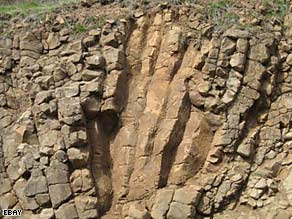
Here’s a new one: an attempt to sell a rockslide rendered Hand of God on eBay.


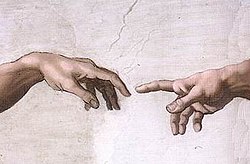
The term “Hand of God” can have very different meanings. Michelangelo’s version from the Sistine Chapel’s “Creation of Adam” is without a doubt the most famous.


But, if you know more about World Cup soccer than art history, Diego Maradona’s infamous “Hand of God goal” from the 1986 Argentina/England World Cup Quarter-Final match probably comes to mind. One of the sport’s most lauded athletes scored two goals on that day, one that he hit in with his hand but was never penalized for, the other a result of Maradona dribbling around 6 British players to score what has since been dubbed “Goal of the Century.” (Argentina won the game, and the World Cup that year.)


If you know about symbolism in antiquity and world religions, “Hand of God” signifies khamsa, or hamsa. The five-fingered figure is believed to have Phoenician origins though it is most commonly associated with Judaism and Islam. Not only do our hands have five fingers, but the Jewish Torah comprises the first five books of the Bible and Islam has its Five Pillars.


According to this CNN report, if you ask Paul Grayhek what the Hand of God looks like, he’ll show you the photograph above, and then try to sell it to you. The Coeur d’Alene, Idaho, resident lost his job and during Lent had been praying. Then on March 8 within a stone’s throw of his home the rocks tumbled, leaving this form, which is about nine feet tall and four feet wide.

Excavating this mass would be expensive, but no worries, you aren’t getting anything material. Says the report: “The buyer will ‘basically be buying the rights, complete and exclusive rights’ to the rock, including literary and movie rights, according to Grayhek.”

He goes on to say: “People think I'm some holier-than-thou person trying to get rich. I'm not . . . The purpose is to spread the story of God and eBay is just a vehicle.”

Well, in this instance eBay is a bit of a jalopy because as of writing this post the item has been removed. Maybe God thought there were better ways to spread His story. Or maybe God’s agent got in touch with Grayhek and explained that literary and movie rights to all rocks and stones have already been sold . . .

Monday, April 20, 2009

Kit Kat Kitsch


Greetings from London, folks. Keeping with the European theme of my current location, the Kit Kat Jesus above was found on Good Friday by some Dutch guy. According to this little blurb (read a translation of the NU.nl letter to the editor here), the guy was on a break and, you guessed it, he broke off a piece of that Kit Kat bar, only to find Jesus.

A brilliant Nestle publicity stunt or a divine snack? Do you think that Kit Kat Easter sales went up in The Netherlands as a result?

More anon . . .

Sunday, April 12, 2009

Myth Makers

Utah Mary

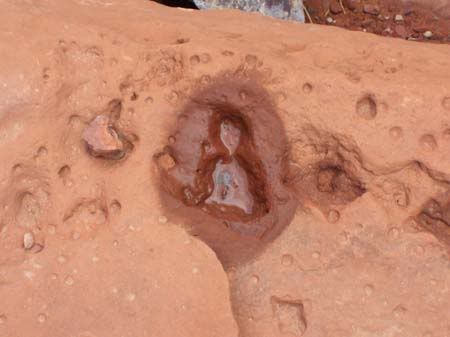
I saw this Virgin Mary image during a recent trip to Colorado and Utah, where the dramatic and ancient landscapes hold many forms and faces. But, of course, what I recognize as a visual manifestation of a religious or secular icon in stone has existed since well before humans and religions. In many of the Madonna of the Toast stories, people see Jesus or the Virgin Mary in a tree or rock, but in the shadow of such grandeur of places like Natural Bridges, Valley of the Gods and Canyonlands I couldn’t help but ponder myth and how it is made visual, and recognizable.

Along with the spires of red rock stacked like totem poles (replete with human-esque faces) and towering canyon walls that reveal millions of years worth of geological history, screaming with Edvard Munch faces, myth cannot be ignored when you also consider the abundance of the region’s petroglyphs and pictographs, most of which were left by the Anasazi (a Navajo word meaning “ancient ones”). I first learned of the Anasazi years ago when I met photographer Nathan Troi Anderson, a very good friend of mine and the impetus for this trip. I had seen his photographs of these symbols, but had never had the chance to look at them in situ. While I’m no expert on the Anasazi, or the American Southwest for that matter, it wasn’t hard for me to put the two subjects within a Madonna of the Toast context.


The exact meanings of these ancient symbols are difficult to define, especially since the Anasazi more or less disappeared, leaving little more than these markings, some structures and various artifacts. But standing in these stunning canyons, looking at the natural contours of stone weathered by time, it is clear that the manmade images respond directly to these natural environments, for it is all these people knew. It was through their interactions with the land, the sky and the seasons that the meaning of life took shape. The shape of these meanings, whatever they might be, are seen in lightning bolt lines, dizzying circles and majestic shaman forms. This is the stuff of myth.

When I saw the Virgin Mary shape in Utah, it was myth speaking to me, though in this case the myth is not as old as the form. For its relative youth, on a geological scale as well as human scale, Christian mythology, particularly that of the Virgin Mary, has proliferated over time. When you consider that Mary is mentioned only 19 times in the Bible (she is mentioned 34 times in the Qu’ran) her popularity is astounding. What do we make of this?

No matter when they came into being or where they were located, all human cultures have their own creation stories in which a mother figure plays a central role. With the Anasazi, as one example, feminine forms are not hard to discern in the petroglyphs and pictographs. Their importance is also bolstered by the belief that the Anasazi held their most sacred ceremonies in manmade ritual caves, or kivas. These areas were built underground so participants would have to go down into them and then later emerge, much like a child exiting the womb.
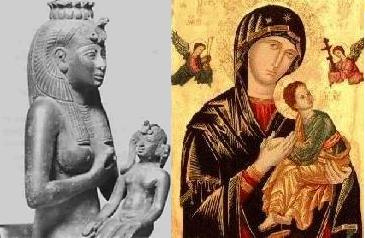


From both the literal and figurative perspectives, the Christ story also possesses this maternal quality, which was recognized and elaborated as Christianity spread. In fact, Western interest in Mary did not flourish until the 12th century, though the power of her myth was recognized all along. According to this Maclean's article, “when nascent Christianity spread to Egypt and encountered the cult of Isis, mother of the god Horus, Mary’s status began to rise even higher. Isis was a powerful and kind-hearted deity, attributes Mary soon acquired.”

The article is essentially a review of Miri Rubin’s Mother of God: A History of the Virgin Mary, which apparently identifies the real power of the Mary myth:

[T]ension—poised between virgin and mother, human and divine—is the source of her endless variety of portrayals, all gracefully traced by Rubin, from the young, sometimes playful, virgin girl to the grief-stricken and empathetic mother at Calvary. The need to ground Mary explains why she did die, as befits a mortal, but was raised bodily to heaven, as befits the mother of God . . . But there was a Mary for everyone, not just motherless clerics, in the flowering of medieval Mariology. For every image of a heavenly queen commissioned by wealthy art patrons, there was a story of the humble carpenter’s wife, particularly gracious to the poor and those who suffered.


This dovetails perfectly with the Madonna of the Toast mantra: What do you see? Throughout time, whether in the form of ancient inscriptions or Biblical stories, the visual manifestations of mythic iconic forms have endured the tests of time because they can represent a range of meanings, depending on the viewers. And while interpretations of the images may vary, they all demonstrate the human need for asserting our presence in this mysterious world where answers are nowhere near as important as interpretations.

Thursday, April 2, 2009

Found in 1972, Making News Today


Joan Reed Carter of Fort Lauderdale, Florida, found this spindly shell back in 1972, while shelling with friends. According to this South Florida Sun-Sentinel article, Carter’s shell has been associated with Jesus since she first picked it up. In fact, one of the friends she was with that day declared: “Well I can't take it home with me because my husband's an atheist.”

Discussing her own relationship with religion Carter said: “Every night my mother would give us a crucifix to kiss. But I like all religions. If I'm near a synagogue I'll go there. If there's a Catholic cathedral, then I'll go there. We all came from the same place and we're all going to end up in the same place."

Over the years anyone that’s seen the shell thinks Carter should do something with it and I guess the approach of Easter inspired her to contact the media. She claims that some people get nervous around the object, not even wanting to touch it. And once, Carter snapped a photo of it but it came out blank. Luckily, the image made itself visible for the newspaper’s photographer.

Worth noting that while the incidence of seeing Jesus and the Virgin Mary in unexpected places has skyrocketed since 1972, Carter claims that no one goes shelling anymore because there are no shells on the beaches.

Monday, March 30, 2009

BBQ Mary


If there’s one thing people take as seriously as religion, it’s barbeque, especially in Texas if these articles from Texas Monthly and The New Yorker serve as indicators. So there is synchronicity to this Virgin Mary image discovered in Odessa on the lid of a grill.

Employees at Reliable Transport Auto Shop first noticed the form a few weeks ago, and since then a shrine has been erected and regular Sunday services have occurred. No word on what these folks had been grilling to create this Mary shape but according to this News West 9 story the employees believe it to be a divine visual manifestation. But they also “say it's up to individuals to judge for themselves.”

Monsignor James Bridges suggests, however, that it is not “authentic,” seeming to care very little about what others think. He asks: “What does it lead people to . . . Does it lead people to be better people? Does it lead people to be deeper in their faith? If all of these things lead to what I would call the agenda of Christ, that would put them in a position of being more believable.”

The word “agenda” always puts me off, and for a priest to use the word in the context of Jesus strikes me as rather absurd. To answer Bridges’s question, it does seem that this image has led "people to be deeper in faith,” hence the weekly services, the candles, rosaries, prayers and hymns.

Madonna of the Toast
stories whip people into action, from the media to the faithful to dissenters. As I write in the book: “Whether on the level of sacrosanct devotion or pop culture kitsch, these forms become as relevant as the world’s finest art because they compel people to react; the objects in this book, emblazoned with faces and symbols recognized the world over, have been appraised at stunningly high sums, been toured around the globe and have inspired people to travel, pray and steal.”

What say you, Monsignor?

Monday, March 23, 2009

Jesus Needed a Haircut


In Greenock, Scotland, according to this Greenock Telegraph report, Karim Babaa was having lunch on a bench when he noticed the face of Jesus on a garden wall. Formed by weathered stone and moss, the image was immediately recognizable to Babaa, a barber and a Muslim. Babbaa works at the Cutting Room (get it?) and when he showed his boss Alan Stocks the wall, he too agreed that it resembled Jesus.

Both men often relax in the garden, which sits between apartment blocks and Westburn Church, but neither of them had noticed the face until recently. Stocks cites the approach of Easter as a possible explanation. I prefer an explanation that factors in the amount of time Babaa and Stocks spend dealing with facial hair.

A local minister had this to say: “I’ve seen the image and, if it amuses people, then that’s fair enough. It all comes down to imagination.”

He’s right. It’s imagination that resulted in Babaa, originally from Tunisia, seeing the face in the first place: “This really looks like the face of Jesus. I’m a Muslim but I read lots of books and that is Jesus.”

Think he’s read Madonna of the Toast?

And speaking of imagination, this story has yielded two of the best captions I’ve read in a while – leave it to those UK tabloid writers:

“Christ-Moss Present” (Greenock Telegraph)

“It moss be him . . .” (The Scottish Sun)